Charles Clarke joins Shearwater
Charles Clarke, the former Labour Home Secretary and former Chairman of the Labour Party, has joined Shearwater as a Senior Advisor and member of the International Advisory Board.
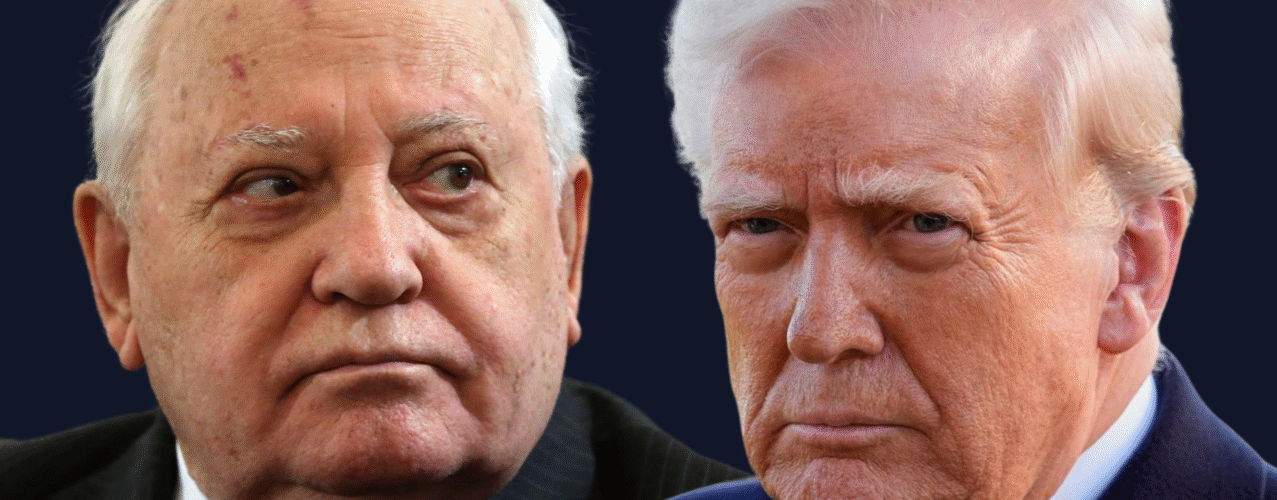
Shearwater Senior Advisor, David Martin, who is also President of the European Movement in Scotland, who was the longest serving United Kingdom MEP, finds leadership behaviour parallels between the last leader of the USSR, Mikhail Gorbachev, and Donald Trump’s White House. He argues that the EU must lead a global collation in defence of rules-based order.
40 years ago, Mikhail Gorbachev, to coin a phrase, set out to make the USSR great again. Gorbachev was acutely aware of the uncompetitive nature of the USSR’s economy and the need to inject market mechanisms into it. He saw Eastern Europe as a drain on the USSR’s standard of living, observing that cheap Soviet exports such as fuel, meant that poorly off Russians were subsidising better-off Poles and Czechs. Furthermore, he noted that while the Soviet Union was spending around 12% of its GNP on defence, this compared with under 6% for its satellites.
Gorbachev used three instruments to try and revitalise the USSR. He introduced Perestroika to restructure the economy on market-based instruments. He decided that to achieve its objectives the Government had to be more open with its population, so Glasnost was launched allowing increased government openness and transparency. Finally. He made it clear to the eastern European communist leaders that the Soviets would no longer intervene to bolster their hold on power. Revolution quickly followed in East Germany, Hungary, Poland, Czechoslovakia, Bulgaria, and Romania. All of whom sought membership of the European Union and NATO.
These moves were all designed not to undermine Communism but to modernise and bolster it. Not to end the USSR, but to strengthen it. While these actions were a logical response to the state of the Soviet Union, Gorbachev had set in train a series of reforms that he could not control. The consequence was the collapse of the Soviet empire and the Soviet Union itself.
The parallels with President Trump are far from exact but the motivation is similar, and the result could also be similar. Both men aimed to revitalise their countries economy and get their partners to pay more for common defence.
Trump has voiced loud and clear his objection to the US paying for Europe’s defence and has undermined confidence in NATO’s Article 5 commitment that an attack on one member would be considered an attack on all. At one level this is fair enough from a US perspective, but the US should not be surprised if its erstwhile allies seek a new alliance just as the Warsaw Pact countries did. Putin’s war on Ukraine is a vicious demonstration of how little influence Russia now has with most of its neighbours.
Notwithstanding his partial climbdown Trump’s tariff war has undermined confidence in the US as a dependable trading partner and a secure country to invest in. The US economy has grown on the back of stable politics, the rule of law and broadly honouring its international commitments. The US was the post war driving force behind the World Trade Organisation, the World Bank, the International Monetary Fund, and the United Nations. All institutions Trump either wants to destroy or weaken. They all need some reform, particularly the WTO, but Trump offers no insight into how they might be reformed leaving a dangerous vacuum.
The dollar as the reserve currency of the world has allowed America to live beyond its means. As recent movements in the Bond market indicate, the world may not for much longer treat the dollar as a safe haven, thus pushing up the cost of US borrowing, encouraging capital flight and reducing investment in the domestic economy. For the whole of the post war period until now the classic response to global economic insecurity was a rush into US bonds. This time investors are dumping US bonds a powerful indication that the world is losing faith in US government bonds as a safe place to store their money and the real reason President Trump made a partial climbdown on tariffs.
Even his opponents in the USSR did not envisage Gorbachev’s reforms bringing down the Soviet empire, far less than in the few years it took. Likewise, Trump’s domestic opponents regard his policies as reckless but not catastrophic. However, he may well have set in train the end of the US ‘empire.’
With President Trump challenging the reliability and competence of the US, Pax Americana appears critically weakened. In 80 days, President Trump has disrupted a system that, despite needing reform, functioned effectively for America and the global economy for 80 years.
It is essential for a coalition of countries to uphold the rule of law and international norms. The European Union, founded on the values of freedom, democracy, and the rule of law, can serve as the cornerstone of such a coalition.
The EU has been reaching out to the CPTPP countries (also known as the Trans-Pacific Partnership). They include some of Trump’s major victims, like Canada, Mexico, and Vietnam, as well as key economies like Japan, Singapore and of course the United Kingdom. Europe has been talking to India about a trade deal. It has concluded one with South American countries. It is now looking for a modus vivendi with China. It is not just the EU that is speeding up the search for new partners. Japan and South Korea are seeking a rapprochement with China something inconceivable just six months ago.
The Trump perspective is that a fragmented global order, where alliances and partnerships are more fluid and issue-specific, benefits the United States. The world needs an alternative approach with a coalition of the willing operating as partners committed to cooperation and the defence of a rules-based order. The European Union has the capacity to help assemble and coordinate such a group. It should aim to create a partnership genuinely based on equality among all members.
The irony of the situation is that, unlike the USSR forty years ago, the American economy was in fact in particularly good health with higher growth than the UK and the EU and relatively low unemployment. What the US required was domestic reform to help those losing out from globalisation not the wholesale destruction of the global economy.